Skip to content

Toile de Jouy
- by Emmanuel Muraille
Arachné Brussels is deeply attached to tradition, and Toile de Jouy is one of its most iconic expressions.
Toile de Jouy is a textile printing technique inspired by the indiennes—printed cotton fabrics that were highly fashionable in the 18th century. In France, Christophe-Philippe Oberkampf (1738–1815) founded the Oberkampf Manufactory in Jouy-en-Josas in 1760, specializing in printed cotton textiles. Its success was immediate. In 1783, the company was granted the prestigious title of Royal Manufactory, joining the ranks of renowned institutions such as the Gobelins tapestry manufactory and the Sèvres porcelain manufactory.
Oberkampf's genius lay not only in his uncompromising commitment to quality but also in his ability to surround himself with exceptionally talented artists.
Initially, each design was painstakingly carved in reverse into wooden blocks. These blocks were inked with dye and repeatedly stamped by hand onto cotton fabric—a slow and labor-intensive process. The introduction of engraved copper rollers revolutionized production, allowing the manufactory to print fabrics at a much faster pace while maintaining remarkable precision.
Following Oberkampf's death, increasing industrial competition, changing tastes and economic difficulties eventually led to the closure of the manufactory in 1843.
Today, the Musée de la Toile de Jouy in Jouy-en-Josas preserves and celebrates this remarkable textile heritage.
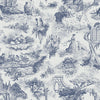
For Arachné Brussels' Spring/Summer 2026 collection, artist Mado Berthet created both an engineered print and a seamless repeat pattern. Drawing inspiration from the figures, architectural settings and pastoral landscapes characteristic of Toile de Jouy, she faithfully reinterpreted the style while respecting the colour palette of the original 18th-century designs.